

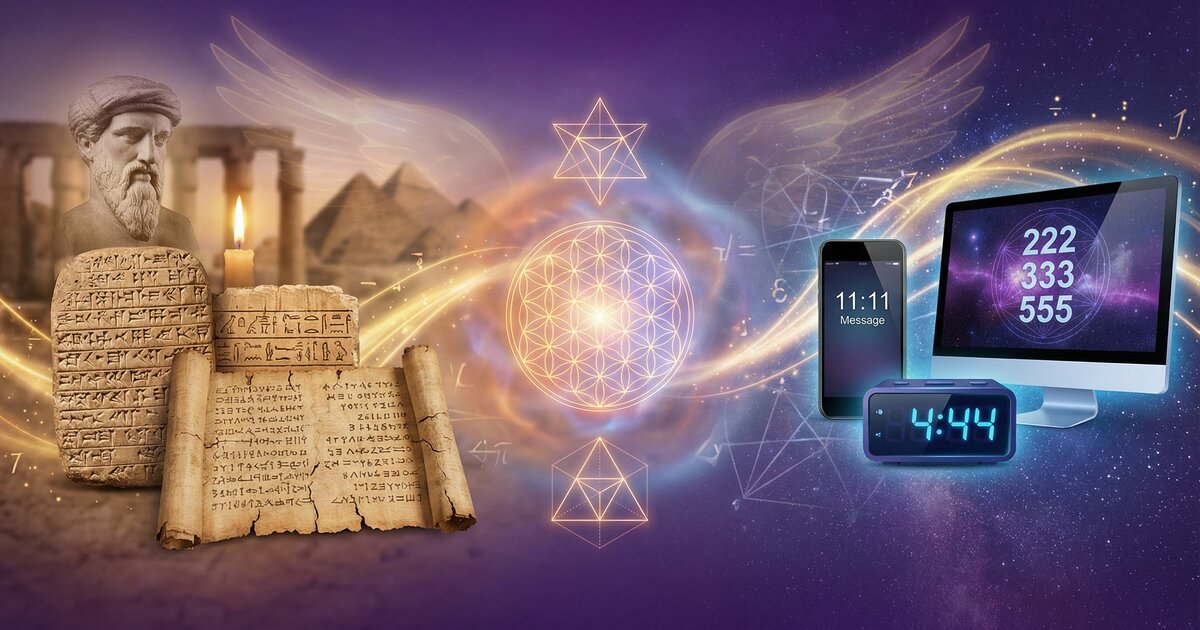
When you see 11:11 on the clock or notice 444 appearing repeatedly in your life, you’re participating in a spiritual practice with roots stretching back thousands of years. While the specific term “angel numbers” is relatively modern, the belief that numbers carry divine significance and spiritual messages is as old as civilization itself.
Understanding the history and origins of angel numbers not only deepens your appreciation for this practice but also reveals why numbers have been considered sacred across virtually every culture throughout human history. From ancient Babylonian mathematics to Pythagorean philosophy, from Hebrew mysticism to modern New Age spirituality, the thread of numerical divinity runs through the entire tapestry of human spiritual experience.
In this comprehensive exploration, we’ll trace the fascinating journey of angel numbers from their ancient origins to their contemporary practice, revealing how this timeless form of divine communication has evolved while maintaining its essential purpose: helping humans connect with higher wisdom and guidance.
If you’re new to angel numbers, you may want to start with our complete beginner’s guide to angel numbers before diving into their historical origins.
Ancient Numerology: The Foundation of Angel Numbers
The story of angel numbers begins with humanity’s earliest civilizations, where numbers were viewed not merely as counting tools but as fundamental forces of the cosmos carrying profound spiritual significance.
Babylonian Mathematics and Mysticism (c. 3000 BCE)
The ancient Babylonians, one of history’s most mathematically sophisticated civilizations, were among the first to assign mystical properties to numbers. Their base-60 number system (which we still use for measuring time and angles) wasn’t just practical—it was sacred.
Babylonian priests believed that numbers were the language of the gods, and they used numerical patterns to predict celestial events, interpret omens, and communicate with divine forces. The number 7, for instance, was considered particularly sacred because of the seven visible celestial bodies (Sun, Moon, Mercury, Venus, Mars, Jupiter, Saturn), a belief that influenced countless later cultures.
Ancient Egypt: Numbers as Divine Architecture (c. 3000 BCE)
The ancient Egyptians embedded sacred numerical principles into their most important structures. The Great Pyramid of Giza, for example, incorporates mathematical ratios and numerical relationships that many believe encode spiritual truths and cosmic principles.
Egyptian priests used numbers in their religious rituals and believed that understanding numerical patterns was key to understanding the divine order of the universe. The number 3 represented plurality and completion, while 4 represented the four cardinal directions and earthly stability—concepts that still appear in modern angel number interpretations.
Ancient China: The I Ching and Numerical Divination (c. 2800 BCE)
In ancient China, the I Ching (Book of Changes) used numerical patterns created by tossing coins or yarrow stalks to divine guidance and predict future events. This system, still practiced today, demonstrates the ancient belief that numbers could reveal hidden truths and provide spiritual guidance.
Chinese culture also developed complex systems of lucky and unlucky numbers based on their pronunciation and symbolic associations. The number 8, for instance, has been considered extremely fortunate for thousands of years—a belief that persists in modern Chinese culture and influences everything from phone numbers to real estate prices.
Pythagoras: The Father of Western Numerology
If we had to identify a single figure most responsible for Western numerological traditions—and by extension, modern angel numbers—it would be the Greek philosopher and mathematician Pythagoras (c. 570-495 BCE).
Pythagoras’s Revolutionary Philosophy
Pythagoras founded a philosophical and religious school in ancient Greece that viewed numbers as the fundamental essence of all reality. His famous declaration, “All is number,” wasn’t just mathematical theory—it was a spiritual worldview.
Pythagoreans believed that:
- Numbers were the building blocks of the universe
- Each number carried specific vibrational qualities and meanings
- Understanding numbers was the key to understanding divine truth
- Mathematical harmony reflected spiritual harmony
The Pythagorean Number Meanings
Pythagoras assigned specific qualities to each number from 1 to 10, creating a system that directly influences modern angel number interpretations:
- 1: The Monad—unity, beginning, source of all
- 2: The Dyad—duality, balance, partnership
- 3: The Triad—harmony, creativity, completion
- 4: The Tetrad—stability, foundation, earthly order
- 5: Change, freedom, human experience
- 6: Harmony, balance, responsibility
- 7: The sacred number—spiritual wisdom, mysticism
- 8: Infinity, abundance, cosmic balance
- 9: Completion, universal love, enlightenment
- 10: Perfection, return to unity
These core meanings, established over 2,500 years ago, form the foundation of modern angel number interpretations. When you see 777, you’re connecting with the same spiritual wisdom that Pythagoras taught about the sacred nature of seven.
Numbers in Religious and Mystical Traditions
As major world religions developed, numerical symbolism became deeply embedded in their sacred texts, rituals, and mystical practices.
Hebrew Gematria and Kabbalah
In Jewish mysticism, the practice of gematria assigns numerical values to Hebrew letters, revealing hidden meanings in sacred texts. Kabbalists believe that understanding these numerical patterns unlocks deeper spiritual truths encoded in the Torah.
The Kabbalistic Tree of Life consists of 10 sephirot (divine emanations), each associated with specific numbers and spiritual qualities. This system has profoundly influenced Western esoteric traditions and modern numerology.
The number 18, for instance, corresponds to the Hebrew word “chai” (life) and is considered especially auspicious in Jewish tradition—a belief that demonstrates how specific numbers can carry cultural and spiritual significance across millennia.
Christian Numerical Symbolism
The Bible is rich with numerical symbolism that has influenced Western spiritual thought for two thousand years:
- 3: The Holy Trinity (Father, Son, Holy Spirit)
- 7: Divine perfection (God created the world in 7 days)
- 12: Divine government (12 tribes of Israel, 12 apostles)
- 40: Testing and trial (40 days of flood, 40 years in wilderness)
- 666: The number of the beast (imperfection, evil)
These biblical number associations continue to influence how people interpret numbers spiritually, including in the context of angel numbers. The significance of 333, for instance, often connects to the Trinity and divine completeness.
Islamic Numerology
Islamic tradition also recognizes the spiritual significance of numbers. The 99 Names of Allah, the five pillars of Islam, and the significance of the number 7 (seven heavens, seven circumambulations of the Kaaba) all demonstrate the importance of numerical symbolism in Islamic spirituality.
The practice of abjad (similar to Hebrew gematria) assigns numerical values to Arabic letters, allowing mystics to find hidden meanings in the Quran and other sacred texts.
Eastern Spiritual Traditions
In Hinduism and Buddhism, numbers carry deep spiritual significance. The number 108, for example, is considered sacred in both traditions—there are 108 beads on a mala (prayer beads), 108 Upanishads, and 108 earthly desires in Buddhist teaching.
The Buddhist concept of the Noble Eightfold Path demonstrates how the number 8 represents spiritual completion and the path to enlightenment—a meaning that resonates with modern interpretations of 888 as a number of abundance and infinite flow.
The Birth of Modern Numerology (19th-20th Century)
While we’ve explored the ancient roots of numerical mysticism, the modern practice of angel numbers as divine messages took shape more recently.
While numerical mysticism has ancient roots, modern numerology as we know it emerged in the late 19th and early 20th centuries, setting the stage for the contemporary angel numbers movement.
L. Dow Balliett: The Pioneer
L. Dow Balliett (1847-1929), an American author and teacher, is credited with bringing Pythagorean numerology into the modern era. Her books, including “The Philosophy of Numbers” (1908), popularized the idea that names and birth dates could be reduced to single digits that revealed personality traits and life paths.
Balliett’s work laid the groundwork for modern numerology by making ancient numerical wisdom accessible to contemporary audiences and applying it to everyday life.
Dr. Juno Jordan: Systematizing Numerology
Dr. Juno Jordan (1884-1984) further developed and systematized numerology in the mid-20th century. Her book “Numerology: The Romance in Your Name” (1965) became a standard reference and helped establish numerology as a respected metaphysical practice.
Jordan emphasized that numbers were vibrational patterns that could reveal an individual’s purpose, challenges, and potential. This concept of numbers carrying specific energetic frequencies became central to angel number philosophy.
The New Age Movement
The New Age movement of the 1960s-1980s created fertile ground for angel numbers to flourish. This era saw renewed interest in:
- Angel communication and divine guidance
- Synchronicity and meaningful coincidences
- Personal spiritual development
- Alternative forms of divination and guidance
The New Age emphasis on personal spiritual experience and direct divine communication created the perfect cultural context for angel numbers to emerge as a popular spiritual practice.
The Modern Angel Numbers Movement (1990s-Present)
The specific concept of “angel numbers” as we know it today emerged in the late 20th century, popularized by spiritual teachers who combined traditional numerology with angel communication.
Doreen Virtue: Popularizing Angel Numbers
Doreen Virtue, a psychotherapist and author, became the most influential figure in popularizing angel numbers in the late 1990s and 2000s. Her books, including “Angel Numbers 101” (2008) and “Angel Numbers” (2005), brought the concept to mainstream audiences.
Virtue’s approach combined traditional numerology with the idea that guardian angels use number sequences as a primary method of communication. She provided specific interpretations for common number sequences like 111, 222, and 444, making angel numbers accessible and practical for everyday spiritual seekers.
While Virtue later renounced her New Age teachings and converted to Christianity, her work had already planted the seeds for a global angel numbers movement that continues to grow independently.
The Digital Age Acceleration
The digital revolution of the 21st century dramatically accelerated the angel numbers phenomenon. Several factors contributed to this explosion:
1. Digital Clocks and Devices: The proliferation of digital clocks, smartphones, and computers means people encounter numbers constantly throughout the day. The iconic 11:11 on digital displays became a cultural phenomenon, with millions of people worldwide reporting seeing this number sequence repeatedly.
2. Social Media Communities: Platforms like Instagram, TikTok, and Reddit created spaces where people could share their angel number experiences, validate each other’s encounters, and spread awareness. Hashtags like #angelnumbers and #1111 have millions of posts, creating a global community of believers and practitioners.
3. Instant Information Access: When someone sees a repeating number, they can immediately search for its meaning online. This instant access to interpretation has made angel numbers more accessible than ever before.
4. Spiritual Awakening Trend: The 2010s and 2020s have seen a surge in interest in spirituality, particularly among younger generations seeking meaning outside traditional religious structures. Angel numbers fit perfectly into this landscape of personal, accessible spiritual practice.
Contemporary Angel Numbers Practice
Today, angel numbers have become a mainstream spiritual practice embraced by millions worldwide. The practice has evolved to include:
- Comprehensive interpretation guides for hundreds of number sequences
- Angel number apps and online tools for instant guidance
- Integration with other spiritual practices (meditation, manifestation, etc.)
- Personalized interpretations based on individual circumstances
- Community support and shared experiences
The practice continues to evolve, with new interpretations and applications emerging as more people engage with angel numbers and share their experiences.
Why Angel Numbers Resonate in the Modern World
Understanding why angel numbers have become so popular in the 21st century reveals something important about contemporary spiritual needs and how ancient wisdom adapts to modern life.
Accessibility and Democracy
Unlike many spiritual practices that require special training, initiation, or expensive tools, angel numbers are completely accessible. Anyone can notice numbers, look up their meanings, and receive guidance. This democratic nature appeals to modern spiritual seekers who want direct access to divine wisdom without intermediaries.
Personal and Immediate
Angel numbers provide immediate, personal guidance that feels relevant to your specific situation. In an era of information overload and generic advice, the specificity and timeliness of angel number messages feel refreshingly personal and meaningful.
Bridge Between Ancient and Modern
Angel numbers successfully bridge ancient spiritual wisdom with modern technology. They honor thousands of years of numerical mysticism while manifesting through digital clocks, smartphones, and contemporary life. This synthesis of old and new makes the practice feel both grounded in tradition and relevant to current times.
Comfort and Reassurance
In uncertain times, angel numbers provide comfort and reassurance that we’re not alone, that there’s a higher order to things, and that we’re being guided and supported. This psychological and spiritual comfort meets a deep human need for meaning and connection.
Empowerment and Agency
Angel numbers empower people to trust their intuition and take inspired action. Rather than creating dependency, the practice encourages personal interpretation and active engagement with divine guidance. This aligns with modern values of personal empowerment and self-directed spirituality.
The Scientific Perspective and Healthy Skepticism
A complete history of angel numbers must acknowledge the scientific perspective and address legitimate skepticism about the phenomenon.
The Baader-Meinhof Effect
Psychologists point to the Baader-Meinhof effect (frequency illusion) to explain why people suddenly start seeing the same numbers everywhere. Once you notice something, your brain becomes primed to notice it again, creating the illusion that it’s appearing more frequently than it actually is.
Confirmation Bias
Skeptics also cite confirmation bias—our tendency to notice and remember information that confirms our existing beliefs while ignoring contradictory evidence. If you believe in angel numbers, you’ll notice when you see 1111 but won’t pay attention to the countless other number combinations you encounter.
The Middle Ground
Many practitioners of angel numbers acknowledge these psychological mechanisms while maintaining that they don’t invalidate the spiritual significance of the practice. The question becomes: Are these psychological effects the explanation, or are they the mechanism through which spiritual guidance operates?
Carl Jung’s concept of synchronicity—meaningful coincidences that can’t be explained by cause and effect—offers a middle ground. Perhaps angel numbers work through both psychological and spiritual mechanisms, with our heightened awareness being precisely how divine guidance reaches us.
Ultimately, the value of angel numbers may lie not in proving their supernatural origin but in the meaning, guidance, and comfort they provide to millions of people worldwide.
Conclusion
The history of angel numbers is a fascinating journey that spans from the ancient temples of Babylon to the smartphones in our pockets today. This practice connects us to thousands of years of human spiritual seeking, to Pythagoras contemplating the divine nature of mathematics, to Hebrew mystics decoding sacred texts, to contemporary spiritual seekers finding guidance in the digital age.
What makes angel numbers so powerful is precisely this deep historical foundation combined with modern accessibility. When you see 444 on a license plate or 11:11 on your phone, you’re participating in a spiritual tradition that honors both ancient wisdom and contemporary experience.
The evolution of angel numbers from ancient numerology to modern spiritual practice demonstrates humanity’s enduring need to find meaning, seek guidance, and connect with something greater than ourselves. Numbers, as the universal language of the cosmos, provide a perfect medium for this connection—transcending culture, language, and time.
To learn more about how angel numbers work in practice and how to start recognizing them in your own life, read our beginner’s guide to angel numbers.
As we move forward into an increasingly digital future, angel numbers will likely continue to evolve and adapt, finding new ways to deliver ancient wisdom through modern technology. The core truth remains unchanged: numbers can speak to us, guide us, and help us navigate our spiritual journey—just as they have for thousands of years.
Ready to explore what angel numbers mean for you? Discover comprehensive interpretations and personalized guidance for any number sequence you’re seeing.
Connect with Thousands of Years of Wisdom
Now that you understand the rich history behind angel numbers, discover what your personal angel numbers mean. Our comprehensive database combines ancient wisdom with modern insights to provide accurate, meaningful interpretations.
Explore Your Angel Numbers →✓ Free to start • ✓ No credit card required • ✓ Instant access

